
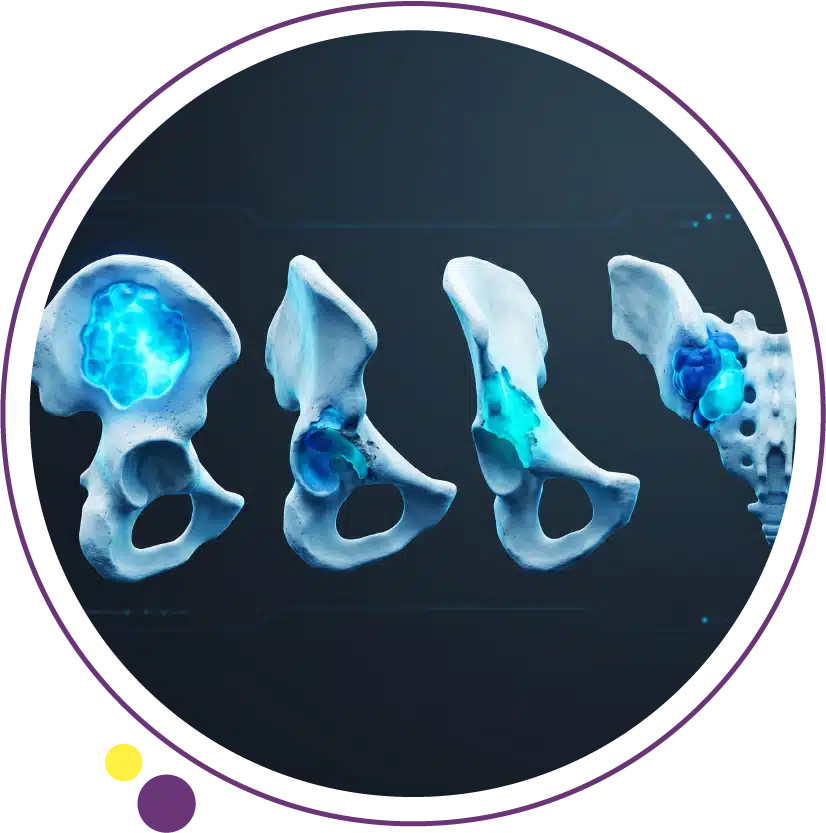
Bone cancer is not a single disease. The term covers a diverse group of malignancies that arise from different cell types within the skeleton, behave differently from one another, affect different age groups, respond to different treatments, and carry different prognoses. Understanding the specific type of bone cancer a patient has is one of the most fundamental steps in planning effective treatment, making an accurate tissue diagnosis essential from the outset.
In this article, we will discuss all the main types of bone cancer, both primary tumors that originate within the bone and secondary tumors that spread to the bone from elsewhere, the key differences between them, which age groups and skeletal locations each type most commonly affects, and how the type of bone cancer influences imaging findings, treatment decisions, and expected outcomes.
Primary vs Secondary Bone Cancer: An Important Distinction
Before discussing individual types, it is important to understand the difference between primary and secondary bone cancer. Primary bone cancer originates in the bone itself, arising from the cells that make up bone, cartilage, or the supporting connective tissue of the skeleton. These are less common but are the focus of bone cancer as a specific disease category. Secondary bone cancer, also called bone metastases, occurs when cancer that started in another organ, such as the breast, lung, prostate, or kidney, spreads to the skeleton. Bone metastases are far more common than primary bone cancers and are managed as an extension of the original primary tumor.
The distinction matters enormously for treatment. A primary osteosarcoma in a teenager is treated with a completely different approach than a bone metastasis from prostate cancer in a sixty-year-old man. Imaging plays a critical role in distinguishing the two, and MRI alongside CT is used to characterise bone lesions and identify the primary site when metastatic disease is suspected. For a complete understanding of what bone cancer investigation involves, our article on how to check for bone cancer outlines the full diagnostic pathway in detail.
Osteosarcoma: The Most Common Primary Bone Cancer
Osteosarcoma is the most common primary malignant bone tumor, accounting for approximately 35 percent of all primary bone cancers. It arises from primitive bone-forming cells (osteoblasts) that produce abnormal osteoid tissue instead of normal bone matrix. The tumor is most common in the metaphyseal regions of long bones, meaning near the growth plates at the ends of bones, with the distal femur (around the knee), proximal tibia, and proximal humerus being the most frequently affected sites.
Osteosarcoma has a bimodal age distribution with a dominant peak in adolescents and young adults between ten and twenty-five years of age during the period of rapid skeletal growth, and a smaller secondary peak in older adults over sixty associated with Paget’s disease or prior radiation. It presents with progressive bone pain, swelling, and sometimes a palpable mass. On X-ray, osteosarcoma often shows a destructive lytic lesion mixed with areas of abnormal bone formation, periosteal reaction including the classic “sunburst” pattern, and a soft tissue mass. MRI defines the local extent of the tumor for surgical planning. Treatment combines pre-operative chemotherapy, limb-salvage surgery or occasionally amputation, and post-operative chemotherapy.
Ewing Sarcoma: The Second Most Common in Young People
Ewing sarcoma is the second most common primary bone cancer in children and young adults, and the most common in those under ten years of age. It arises from primitive neuroectodermal cells within the bone marrow, and its defining molecular event is a chromosomal translocation producing the EWSR1-FLI1 fusion oncogene. Ewing sarcoma can affect any bone but has a predilection for the pelvis, femur, tibia, and the flat bones of the chest wall, with a notable proportion arising in the shaft (diaphysis) of long bones rather than the metaphysis, distinguishing it anatomically from osteosarcoma.
Clinically, Ewing sarcoma is notable for producing prominent systemic symptoms including fever, weight loss, and elevated inflammatory markers that can mimic bone infection (osteomyelitis), making it one of the most diagnostically challenging bone tumors. On X-ray, it typically produces a permeative (moth-eaten) lytic lesion with aggressive periosteal reaction, sometimes showing the classic “onion skin” layering pattern. MRI demonstrates extensive marrow involvement and often a large soft tissue component that exceeds the bony abnormality on X-ray. Treatment involves multi-agent chemotherapy combined with local control through surgery, radiotherapy, or both depending on the site and resectability of the tumor.
Chondrosarcoma: The Most Common Bone Cancer in Middle-Aged Adults
Chondrosarcoma is the most common primary bone cancer in adults over forty and the second most common primary bone cancer overall. It arises from cartilage-forming cells (chondroblasts) and produces abnormal cartilage matrix rather than normal bone. Unlike osteosarcoma and Ewing sarcoma, chondrosarcoma most commonly affects middle-aged and older adults, with peak incidence between forty and seventy years of age. The pelvis, proximal femur, proximal humerus, and ribs are the most frequently affected sites.
Chondrosarcoma is characterised by a wide spectrum of biological behavior. Low-grade chondrosarcomas grow slowly and have a relatively low risk of metastasis, while high-grade tumors are aggressive and can spread to the lungs and other organs. Because the tumor is composed of cartilage, chemotherapy and radiation are largely ineffective, making surgery the primary and often only effective treatment. This makes complete surgical excision with wide margins critical for cure. On imaging, chondrosarcomas show characteristic rings and arcs of calcified cartilage matrix on X-ray and CT, and MRI is used to assess the extent of marrow involvement, cortical breakthrough, and soft tissue spread. The imaging services at Images support the detailed pre-surgical assessment these tumors require.
Chordoma: A Rare Tumor of the Spine and Skull Base
Chordoma is a rare, slow-growing malignant tumor arising from remnants of the notochord, the embryonic structure that gives rise to the vertebral column during development. Because of its notochordal origin, chordoma occurs exclusively along the axial skeleton: approximately half arise in the sacrococcygeal region at the base of the spine, about one third in the skull base, and the remainder in the mobile spine between the cervical and lumbar vertebrae. Chordoma is most commonly diagnosed in adults between forty and sixty years of age and is roughly twice as common in men as in women.
Despite its slow growth, chordoma is a locally aggressive tumor with a strong tendency for local recurrence after surgical resection, and it can metastasise to the lungs and other organs over time. Sacrococcygeal chordomas typically present with deep, dull sacral or buttock pain, bowel or bladder dysfunction, and sometimes a palpable mass. Skull base chordomas may present with headache, diplopia, cranial nerve dysfunction, and other neurological symptoms depending on which structures are compressed. MRI is the primary imaging modality for chordoma evaluation because of its superior soft tissue detail and ability to define the relationship of the tumor to the spinal cord, nerve roots, and critical vascular structures. CT complements MRI by characterising the bony destruction pattern. The Images team can arrange both studies efficiently for patients in Kuwait requiring this type of axial skeletal evaluation.
Fibrosarcoma and Undifferentiated Pleomorphic Sarcoma
Fibrosarcoma of bone and undifferentiated pleomorphic sarcoma (UPS) are high-grade primary bone tumors that arise from the fibrous connective tissue within bone. They are rare, accounting for a small percentage of primary bone cancers, and they tend to affect adults in the fourth to sixth decades of life. Both are aggressive malignancies with a significant risk of lung metastasis and generally carry a less favourable prognosis than early-stage osteosarcoma treated in specialised centers.
Fibrosarcoma of bone presents as a purely lytic (bone-destroying) lesion on X-ray without the calcification pattern seen in chondrosarcoma or the new bone formation typical of osteosarcoma. The metaphysis of long bones is the most common location. Because these tumors share several imaging characteristics with other aggressive lytic bone lesions, biopsy is essential for definitive histopathological classification. Treatment involves surgical resection with or without adjuvant chemotherapy or radiotherapy depending on tumor grade. The X-ray findings in these cases prompt urgent referral for MRI staging before biopsy planning, following the same pathway described in the bone cancer diagnostic guide. For a thorough understanding of the symptoms that prompt investigation, our article on bone cancer symptoms covers this in detail.
Giant Cell Tumor of Bone
Giant cell tumor (GCT) of bone occupies an unusual position in the classification of bone tumors because it is technically a benign tumor in most cases but behaves in a locally aggressive manner and has a small but real potential for malignant transformation and metastatic spread, particularly to the lungs. It arises from the stromal cells of the bone marrow and is characterized by the presence of large numbers of osteoclast-like giant cells under the microscope.
GCT most commonly affects young adults between twenty and forty years of age and has a predilection for the epiphyseal ends of long bones, particularly the distal femur, proximal tibia, distal radius, and sacrum. It presents with pain, swelling, and often joint stiffness. On X-ray, GCT appears as an eccentric, lytic lesion extending to the articular surface of a long bone, classically described as a “soap bubble” appearance. MRI is essential for defining the full extent of the lesion and assessing for soft tissue extension or joint involvement. Treatment options include intralesional curettage with adjuvant agents, resection for aggressive cases, and denosumab, a targeted therapy that inhibits the osteoclast activity driving the tumor’s destructive behavior. The imaging services at Images support the complete pre-operative planning for GCT cases in Kuwait.
Secondary Bone Cancer: Metastases From Other Cancers
Secondary bone cancer, or skeletal metastases, is far more common than any type of primary bone cancer. Many solid tumors spread to the skeleton as part of their natural history, with the most common primary sources including breast cancer, prostate cancer, lung cancer, kidney cancer, and thyroid cancer. Myeloma, a cancer of plasma cells within the bone marrow, also produces extensive skeletal involvement that produces lytic lesions on imaging closely resembling metastatic deposits.
Bone metastases typically produce pain that is often worse at night, and they can cause pathological fractures, hypercalcaemia (elevated blood calcium), and spinal cord compression when vertebral lesions cause collapse or retropulsion. The distribution of metastases tends to follow the red marrow, concentrating in the axial skeleton including the spine, pelvis, ribs, and skull, and in the proximal long bones. CT scanning of the chest, abdomen, and pelvis is used to assess the extent of systemic disease, while whole spine MRI is used when cord compression is suspected. Our previously published article on CT scan uses provides further context on how CT supports the evaluation of metastatic bone disease in the broader oncology setting.
How Type Determines Treatment and Outcome
The type of bone cancer is the single most important factor in determining the treatment approach and prognosis. Osteosarcoma is treated with chemotherapy and surgery; chondrosarcoma requires surgery alone in most cases because it is resistant to both chemotherapy and radiation. Ewing sarcoma is highly chemotherapy-sensitive but requires careful local control planning. Chordoma is treated primarily with surgery and often proton beam radiotherapy. Giant cell tumor is managed with intralesional or resective surgery and sometimes targeted therapy. Secondary bone cancer is managed as a manifestation of the underlying primary cancer with systemic treatment, local radiotherapy, and orthopedic stabilisation when fracture risk is high.
Getting the type right therefore matters enormously, and this requires a combination of imaging findings, histopathological analysis of biopsy tissue, and molecular profiling where relevant. No clinical assessment or imaging study can replace biopsy in confirming tumor type with certainty. The imaging information from X-ray, MRI, and CT shapes the differential diagnosis and guides where and how the biopsy is performed, which directly affects the quality of the tissue sample and the accuracy of the histopathological result. For patients in Kuwait, Images Diagnostic Center provides all three imaging modalities across its three branches to support the complete bone tumor diagnostic pathway.
Frequently Asked Questions
Which type of bone cancer is most common?
Among primary bone cancers, osteosarcoma is the most common overall, followed by chondrosarcoma and Ewing sarcoma. However, secondary bone cancer (metastases from other primary tumors) is far more common than any primary bone cancer type. In adults presenting with bone lesions, secondary metastases are statistically the most likely diagnosis by a significant margin, which is why identifying the primary tumor source is a key early step in the diagnostic workup.
Which bone cancers are most common in children?
Osteosarcoma and Ewing sarcoma are the most common primary bone cancers in children and adolescents. Osteosarcoma peaks in the adolescent growth spurt years and is the more common of the two. Ewing sarcoma is the most common bone cancer in children under ten. Both present with bone pain, swelling, and sometimes systemic symptoms and both require urgent imaging and specialist referral when suspected.
Is chondrosarcoma treatable with chemotherapy?
Conventional chondrosarcoma is largely resistant to both chemotherapy and radiotherapy, making surgery the cornerstone of treatment. The goal of surgery is complete wide-margin resection, which is the main determinant of outcome. High-grade and dedifferentiated chondrosarcomas, which are more aggressive subtypes, may receive chemotherapy in addition to surgery, but the response rates are much lower than those seen in osteosarcoma or Ewing sarcoma.
How does imaging help determine which type of bone cancer is present?
Each bone cancer type has characteristic imaging features that contribute to the differential diagnosis. Osteosarcoma shows mixed lytic and sclerotic lesions with periosteal reaction and new bone formation. Ewing sarcoma produces permeative lytic destruction with aggressive periosteal reaction. Chondrosarcoma shows rings and arcs of calcified cartilage matrix. Giant cell tumor appears as an eccentric epiphyseal lytic lesion. Chordoma produces destructive sacral or skull base lesions with soft tissue components. While imaging strongly suggests the type, tissue diagnosis through biopsy always provides the definitive answer. The Images team can arrange the relevant imaging for your specialist’s assessment.
Can bone metastases be mistaken for primary bone cancer?
Yes, and this is a genuine diagnostic challenge. Lytic bone metastases from a known or unknown primary tumor can look radiologically similar to primary bone cancer, particularly in adults. The age of the patient, the location of the lesion, the clinical history, and the presence of multiple lesions versus a solitary one all help guide the differential diagnosis. Multiple lytic lesions throughout the skeleton in an adult strongly favour metastases or myeloma. A solitary aggressive lesion in a teenager near the knee strongly favours primary osteosarcoma. Cross-sectional imaging and biopsy together resolve the uncertainty in the majority of cases.
Knowing the Type Is the Starting Point for Everything That Follows
The type of bone cancer determines the treatment plan, the chemotherapy regimen if one is appropriate, the surgical approach, the radiation strategy, and the surveillance schedule after treatment. No two types are managed identically, and even within a single type the grade and molecular characteristics further refine the treatment approach. The diagnostic process that leads to a confirmed type and grade is therefore not a formality but the foundation on which the entire treatment plan is built.
At Images Diagnostic Center, X-ray, 3 Tesla MRI, and CT scan services across three Kuwait branches support the imaging component of this diagnostic process from first suspicion to pre-surgical planning:
To arrange imaging for a suspected bone lesion or discuss the right diagnostic pathway for your situation, contact Images directly.