
Checking for bone cancer is not a single test or a straightforward process. Because bone cancer is relatively uncommon and its symptoms overlap with many more frequent conditions, the diagnostic journey typically involves several steps, each building on the last. It begins with clinical assessment, moves through imaging, and concludes with tissue sampling to deliver a confirmed diagnosis that guides treatment planning.
Knowing what each test involves, what it can and cannot tell you, and how the results fit together helps patients approach this process with greater clarity and less anxiety. In this article, we will discuss each method used to check for bone cancer, from the initial physical examination and plain X-ray through to MRI, CT scanning, bone scan, blood tests, and biopsy, along with what to expect at each stage and how the results connect to a final diagnosis.
Starting With a Physical Examination and Clinical History
The diagnostic process for bone cancer almost always begins with a thorough clinical assessment. A doctor will ask detailed questions about the nature of the pain: when it started, whether it is present at night, whether it is getting worse over time, whether there has been any trauma, and what makes it better or worse. They will also ask about systemic symptoms such as unexplained weight loss, fever, and fatigue. This history is critical because bone cancer has specific patterns that help distinguish it from benign bone conditions and soft tissue problems.
Physical examination includes palpating the affected area for tenderness, swelling, warmth, and the presence of a palpable mass. Joint range of motion is assessed, and the regional lymph nodes are checked. The neurological examination is important when spinal involvement or nerve compression is suspected. While the clinical examination rarely provides a definitive diagnosis, it shapes the imaging and investigation pathway that follows. At Images Diagnostic Center, the imaging team works closely with referring clinicians to ensure the most appropriate scan protocol is selected for each individual patient presentation.
X-Ray: The Essential First Imaging Step
Plain X-ray of the suspected area is almost universally the first imaging study performed when bone cancer is being considered. It is fast, widely accessible, and provides an immediate overview of the bone’s structure. On X-ray, bone tumors may appear as lytic lesions (areas where bone has been destroyed and appears darker), sclerotic lesions (areas of abnormal bone density appearing whiter), or a mixture of both. Periosteal reaction, which is new bone formation along the outer surface in response to a tumor pushing against the periosteum, is a highly significant finding that raises strong suspicion for a primary bone malignancy.
X-ray is also used to assess whether a fracture has occurred through a bone lesion and to evaluate the overall integrity of the affected bone. While a normal X-ray does not exclude bone cancer in its very earliest stages, most clinically significant bone tumors will produce visible changes on plain X-ray by the time they are causing symptoms. The digital X-ray service at Images provides high-quality bone imaging across all three Kuwait branches, with rapid reporting to support prompt clinical decision-making. For more detail on what X-ray can and cannot show in different clinical contexts, our article on diagnostic X-ray provides a comprehensive reference.
MRI: The Most Detailed View of the Lesion and Surrounding Tissue
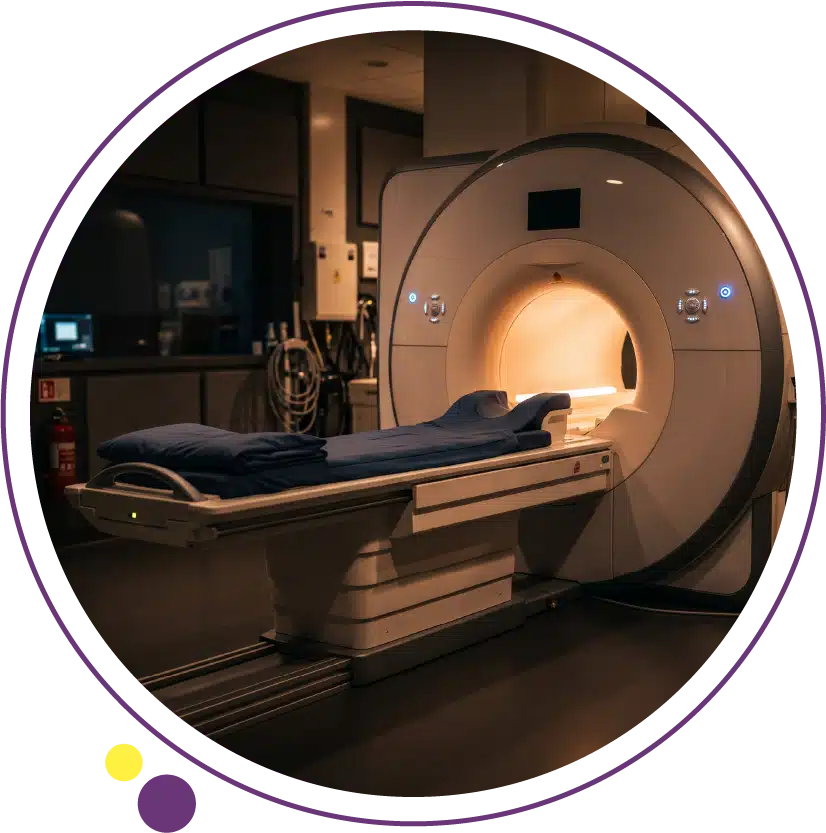
MRI is the most informative imaging modality for evaluating a suspected bone tumor once it has been identified on X-ray or clinically suspected. It provides exquisite detail of bone marrow involvement, soft tissue extension, the relationship of the tumor to nearby nerves and blood vessels, and the integrity of the articular cartilage and joint. These details are critical not only for diagnosis but for determining whether the tumor can be resected with adequate margins and what surgical approach would be most appropriate.
MRI sequences used in bone tumor evaluation include T1-weighted images, which define anatomy and detect bone marrow replacement; T2-weighted fat-suppressed sequences, which show edema and soft tissue involvement; and contrast-enhanced sequences, which assess vascularity and can help differentiate viable tumor from necrosis. The 3 Tesla MRI available at Images delivers the high spatial resolution needed for these detailed evaluations, making it the preferred choice for pre-surgical bone tumor planning in Kuwait. For patients who experience anxiety in enclosed scanners, the Open MRI option is also available and can be arranged to accommodate comfort needs.
CT Scan: Assessing Bone Detail and Staging Disease
CT scanning plays two important roles in bone cancer evaluation. First, it provides superior cortical bone detail compared to MRI, allowing precise assessment of how much the tumor has destroyed or remodeled the bony cortex. This is particularly valuable for complex anatomical sites such as the pelvis, sacrum, and vertebral column where the three-dimensional architecture of the bone is important for surgical planning. Second, and critically, CT of the chest is the standard staging study for bone cancer because the lungs are the most common site of metastatic spread from primary bone tumors, particularly osteosarcoma.
A CT scan of the chest at diagnosis identifies whether lung metastases are present at the time of initial staging, which significantly influences treatment decisions. Some centers also perform CT of the abdomen and pelvis depending on the specific bone cancer type and clinical picture. For a detailed understanding of what CT contributes to oncological staging beyond plain imaging, our previously published article on CT scan uses provides useful background context. The CT scan service at Images is available across all three Kuwait branches to support both local tumor assessment and staging evaluation.
Bone Scan and PET Scan: Whole-Body Disease Assessment
A bone scan, also known as a radionuclide bone scan, uses a small amount of radioactive tracer that is injected into the bloodstream and taken up by metabolically active bone. Areas of increased bone turnover, including tumors and metastases, show as “hot spots” on the scan. Bone scan is useful for assessing whether bone cancer has spread to other parts of the skeleton, which can happen in both primary bone cancer and when bone cancer is secondary to a primary tumor elsewhere in the body. It provides a whole-body skeletal survey in a single study.
PET-CT combines metabolic imaging with anatomical CT imaging and provides the most comprehensive whole-body assessment of disease activity and extent. It is particularly useful in staging aggressive bone tumors and in assessing treatment response after chemotherapy. PET-CT shows areas of metabolically active disease with great sensitivity and, when combined with the anatomical detail of CT, provides precise localization of both skeletal and soft tissue disease. When your clinical team requests staging imaging as part of a bone cancer workup, the full imaging services at Images support the components of that evaluation that fall within radiology, with efficient coordination and reporting.
Blood Tests: What They Can and Cannot Reveal
There is no single blood test that diagnoses bone cancer directly. However, blood tests play an important supporting role in the overall evaluation. Alkaline phosphatase (ALP) is an enzyme found in bone-forming cells, and elevated levels are seen in many patients with osteosarcoma because the tumor produces large amounts of it. Lactate dehydrogenase (LDH) is elevated in Ewing sarcoma and its level has prognostic significance. These are not diagnostic on their own, but in the right clinical context they contribute to the assessment.
Blood tests are also used to rule out other conditions that can mimic bone cancer, including bone infection (osteomyelitis) and metabolic bone disease. Full blood count, inflammatory markers, calcium, phosphate, vitamin D, and parathyroid hormone levels are all commonly requested. Blood protein electrophoresis is used to look for abnormal proteins suggestive of multiple myeloma, which is a blood cancer that frequently involves the skeleton and can look very similar to primary bone cancer on X-ray. Understanding what the blood tests show alongside the imaging findings gives the clinical team the most complete picture before proceeding to biopsy. Arranging the imaging component of this workup is straightforward at Images, where scans can be coordinated efficiently with your referring specialist.
Biopsy: The Step That Confirms the Diagnosis
A biopsy is the only way to confirm a bone cancer diagnosis definitively. No imaging study, however detailed, can determine with certainty whether a bone lesion is benign or malignant, or identify the specific type and grade of cancer, without tissue analysis. The biopsy provides material for histopathological examination, immunohistochemistry, and molecular profiling, all of which directly determine the treatment plan.
Two main types of biopsy are used in bone tumor diagnosis. A core needle biopsy, guided by CT or ultrasound, uses a hollow needle to remove small cylinders of tissue from the lesion with minimal invasiveness. This is the standard approach for most accessible bone tumors. An open surgical biopsy, performed in the operating theatre, provides a larger tissue sample and is used when needle biopsy is technically difficult or when the initial needle biopsy result is inconclusive. Critically, the biopsy must be planned and performed by a specialist orthopedic oncology team because the biopsy tract is considered contaminated and must be excised during definitive surgery. Poorly planned biopsies can compromise subsequent surgical options.
Before biopsy, MRI of the tumor provides the roadmap that guides the biopsy approach, identifying the most accessible and representative part of the tumor while avoiding critical structures. The CT scan may be used to guide the needle in real time for deep or complex anatomical locations. Both services are available at Images to support the pre-biopsy imaging planning that orthopedic oncology teams rely on.
What to Expect During the Diagnostic Process
The diagnostic process for bone cancer typically spans two to four weeks from initial clinical presentation to a confirmed tissue diagnosis, depending on how quickly each step is arranged and how straightforward the case is. It begins with a GP or emergency department referral to an orthopedic surgeon or orthopedic oncologist, who will arrange the initial imaging and, if warranted, the biopsy. The imaging results are discussed in a multidisciplinary tumor board meeting that typically includes orthopedic surgeons, radiologists, oncologists, and pathologists, before a final treatment plan is agreed.
Patients undergoing this process in Kuwait can arrange the imaging components quickly at Images, with reporting delivered efficiently to their referring specialist. Bringing all imaging on a single platform, including X-ray, MRI, and CT, simplifies the process and ensures that the reporting team has access to the complete picture at each stage. If you have been referred for bone imaging as part of a diagnostic workup, the Images team can guide you on what each scan involves and how to prepare, ensuring your appointment is as efficient and comfortable as possible. For readers wanting to understand what different types of CT scanning contribute to diagnostic workups, our published guide on types of CT scan covers this in accessible detail.
Frequently Asked Questions
Can a doctor tell if it is bone cancer from X-ray alone?
X-ray can identify suspicious bony lesions and provide strong circumstantial evidence for a bone tumor, but it cannot confirm bone cancer on its own. The appearance of a lesion on X-ray can suggest whether it is likely benign or malignant, and certain features such as aggressive periosteal reaction are highly suggestive of malignancy. However, a definitive diagnosis always requires histopathological analysis of a biopsy sample. X-ray findings guide the urgency and type of further investigation, including whether MRI or CT is needed next.
Is MRI or CT better for checking bone cancer?
Both modalities are essential and serve different purposes. MRI is superior for evaluating the local extent of the tumor, bone marrow involvement, and soft tissue spread. CT is better for assessing cortical bone detail and for staging the lungs and distant organs for metastatic spread. In bone cancer workup, both are typically performed at some stage, with MRI used for local tumor assessment and CT used for staging. Neither replaces the other, and together they provide complementary information.
How long does it take to get a bone cancer diagnosis?
From initial clinical presentation to confirmed histopathological diagnosis typically takes two to four weeks in well-coordinated specialist settings. This includes time for imaging, specialist review, biopsy planning, the biopsy procedure itself, and laboratory processing of the tissue sample. Delays can occur at any step, which is why prompt referral to a specialist when a bone lesion is suspected is important. Timely access to imaging at Images reduces one of the main potential bottlenecks in this pathway.
Does a bone biopsy hurt?
A core needle biopsy is performed under local anesthesia and patients typically experience pressure and mild discomfort rather than significant pain during the procedure. Some post-procedure soreness at the biopsy site is common for a day or two afterward. Open surgical biopsies are performed under general or regional anesthesia and involve a longer recovery. The discomfort is generally well managed and should not be a reason to avoid a biopsy when one is clinically indicated.
Can blood tests alone detect bone cancer?
No. There is no blood test that can diagnose bone cancer on its own. Elevated alkaline phosphatase and LDH are associated with certain bone cancer types and contribute to the overall clinical picture, but they are non-specific and can be elevated in many other conditions. Blood tests are used alongside imaging and biopsy rather than as a replacement for them.
Getting the Right Tests in the Right Order
Checking for bone cancer follows a logical and well-established sequence. Clinical assessment points toward imaging, imaging points toward biopsy, and biopsy delivers the tissue diagnosis that guides treatment. Skipping or rushing any step can compromise the quality of information available to the clinical team and, in the case of biopsy planning, can affect surgical options. The most important contribution any patient can make to this process is seeking medical attention promptly when the symptoms described in the bone cancer symptoms guide are present, and then ensuring imaging is arranged without unnecessary delay.
Images Diagnostic Center provides X-ray, 3 Tesla MRI, and CT scanning across three branches in Kuwait to support every stage of bone cancer investigation:
To arrange your scan or discuss the imaging steps relevant to your situation, contact Images directly.