

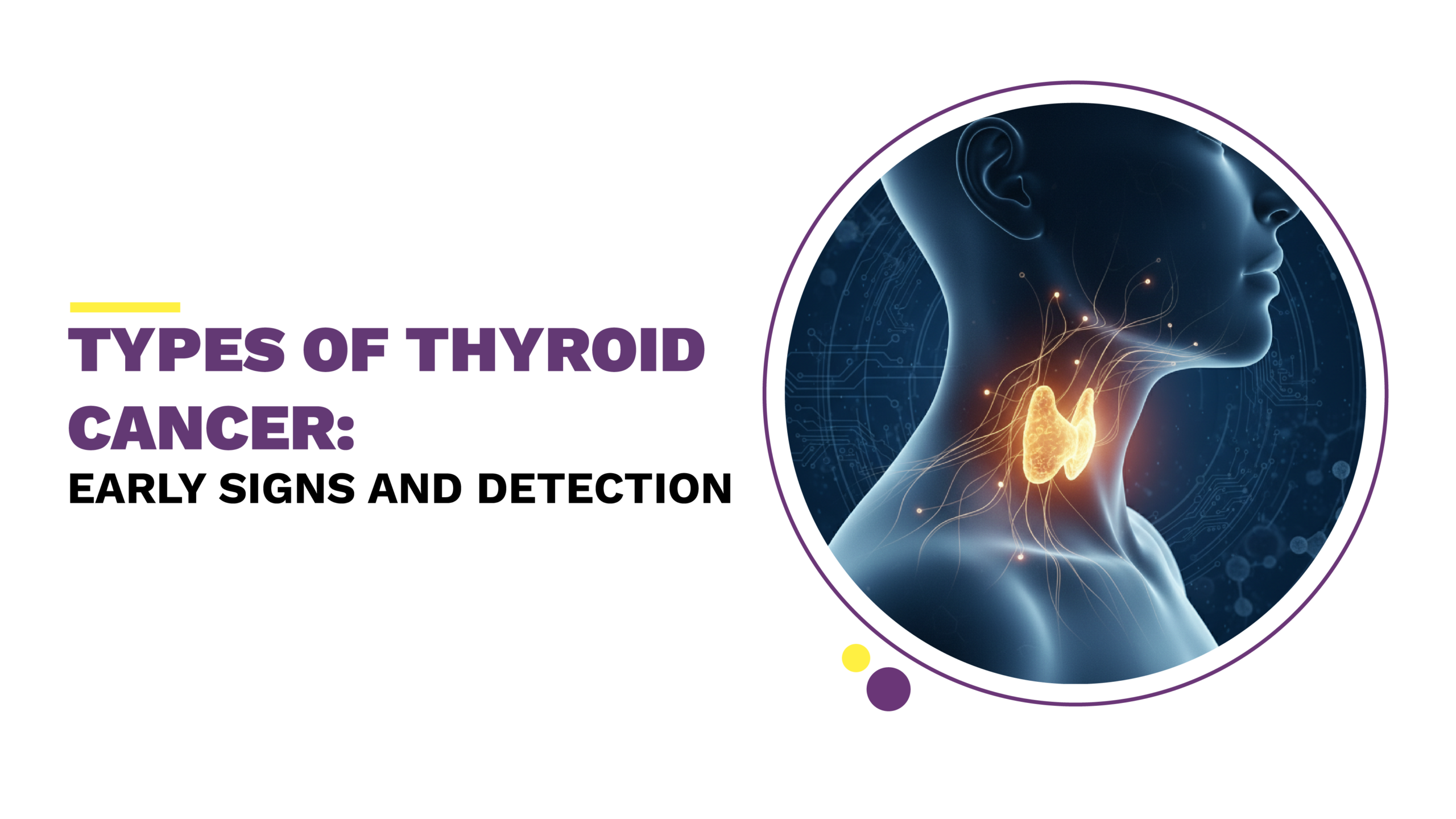
Thyroid cancer is one of the fastest-growing diagnosed cancers worldwide, not necessarily because it is becoming more aggressive, but because advanced diagnostic imaging now allows much earlier and more accurate detection.
In Kuwait, where access to high-resolution medical imaging has significantly improved, radiology plays a central role in identifying thyroid abnormalities before symptoms escalate or complications arise.
At Images Diagnostic Center, thyroid evaluation is approached through precision imaging, subspecialty radiology expertise, and patient-centered diagnostic protocols. Understanding the types of thyroid cancer, how they present, and which imaging tools are most effective for detection is essential for patients, families, and referring physicians seeking reliable clinical answers.
This guide explains the main types of thyroid cancer, their early warning signs, and how modern imaging, including ultrasound, CT scans, MRI, and specialized radiology interpretation, supports accurate diagnosis and treatment planning.
Understanding thyroid cancer and why imaging matters
The thyroid gland is a small, butterfly-shaped organ located at the base of the neck. Despite its size, it plays a critical role in regulating metabolism, heart rate, and body temperature. Thyroid cancer develops when abnormal cells grow uncontrollably within the gland.
What makes thyroid cancer unique from a diagnostic standpoint is that many cases are asymptomatic in early stages, making imaging often the first indicator of disease, rather than symptoms alone.
High-quality diagnostic imaging helps:
- Detect small thyroid nodules before they become clinically apparent
- Differentiate benign from suspicious nodules
- Assess local spread to lymph nodes
- Guide biopsy and surgical planning
- Monitor recurrence or progression
What are the main types of thyroid cancer?
Thyroid cancer is not a single disease. It includes several distinct types, each with different behavior, risk profiles, and imaging characteristics.
Papillary thyroid cancer (PTC)
Papillary thyroid cancer is the most common type, accounting for approximately 80% of cases.
Key characteristics:
- Slow-growing
- Often detected incidentally on ultrasound
- High survival rate when diagnosed early
Early signs may include:
- A painless neck lump
- Enlarged cervical lymph nodes
- Subtle voice changes
Imaging role: High-resolution thyroid ultrasound is the primary diagnostic tool. Suspicious features include microcalcifications, irregular margins, and hypoechogenicity. At Images Diagnostic Center, ultrasound examinations are performed with advanced Doppler capability, allowing precise vascular assessment of nodules.
Follicular thyroid cancer (FTC)
Follicular thyroid cancer represents about 10–15% of thyroid cancers and tends to spread through the bloodstream rather than lymphatic channels.
Key characteristics:
- More common in iodine-deficient populations
- Can spread to lungs or bones
- Requires careful imaging follow-up
Imaging role: Ultrasound helps identify suspicious nodules, but CT scans and MRI are often required to assess potential distant spread. Advanced MRI for accurate diagnosis is particularly valuable when evaluating soft tissue extension without radiation exposure.
Medullary thyroid cancer (MTC)
Medullary thyroid cancer originates from parafollicular C-cells and may be associated with genetic syndromes.
Key characteristics:
- May produce elevated calcitonin levels
- Can be sporadic or inherited
- Requires comprehensive imaging assessment
Imaging role: In addition to ultrasound, CT imaging protocols are used to evaluate lymph nodes, chest involvement, and mediastinal structures. CT scan accuracy is critical for staging and surgical planning in these cases.
Anaplastic thyroid cancer
Anaplastic thyroid cancer is rare but aggressive, often presenting at an advanced stage.
Key characteristics:
- Rapid growth
- Compression symptoms (difficulty breathing or swallowing)
- Requires urgent diagnosis
Imaging role: CT scans provide rapid assessment of airway compromise, while MRI scans help delineate soft tissue invasion. At Images Diagnostic Center, imaging protocols prioritize speed and clarity for urgent oncologic evaluation.
What makes thyroid ultrasound the first diagnostic step?
Ultrasound is the cornerstone of thyroid imaging because it offers real-time, radiation-free visualization of the gland and surrounding structures.
Why ultrasound is essential:
- Detects nodules as small as 2–3 mm
- Evaluates internal composition (solid vs cystic)
- Assesses lymph node involvement
- Guides fine-needle aspiration biopsy
At Images Diagnostic Center, ultrasound examinations are performed by experienced radiologists using high-frequency probes optimized for neck imaging, ensuring radiology accuracy and consistent reporting standards.
When is CT or MRI used in thyroid cancer diagnosis?
While ultrasound is ideal for initial assessment, advanced imaging becomes essential in specific scenarios.
CT scan applications
- Assessing retrosternal extension
- Evaluating lymph node chains
- Pre-operative anatomical mapping
How fast can CT scan results be obtained?
At Images Diagnostic Center, most CT scan results are interpreted and delivered within hours, allowing rapid clinical decision-making for oncologic cases.
MRI scan applications
- Soft tissue invasion assessment
- Vascular involvement
- Recurrent disease evaluation
3 Tesla MRI scan in Kuwait provides exceptional soft tissue contrast, especially valuable when ultrasound findings are inconclusive or when avoiding radiation is preferred.
How imaging supports early detection and better outcomes
Early detection significantly improves prognosis across all thyroid cancer types. Imaging allows clinicians to intervene before tumors affect vital neck structures or metastasize.
Benefits of early imaging-based detection include:
- Less extensive surgery
- Reduced complication rates
- Better long-term disease control
- More conservative treatment options
Images Diagnostic Center integrates imaging findings with clinical diagnosis pathways, ensuring radiology contributes meaningfully to patient outcomes rather than functioning as an isolated test.
Role of breast imaging and bone density in thyroid cancer care
Although thyroid cancer primarily involves the neck, comprehensive diagnostic care may include additional imaging depending on patient risk factors.
- Bone Density (DEXA Scan): Used in patients undergoing long-term thyroid hormone therapy, which may affect bone health.
- Mammography: For women with thyroid disorders, breast imaging may be recommended as part of broader endocrine health surveillance.
Home radiology service for follow-up and vulnerable patients
Not all patients can easily travel for imaging, especially elderly individuals or those recovering from surgery.
Home radiology service Kuwait (Images GO) provides:
- Mobile ultrasound
- Portable X-ray imaging
- Radiologist-reviewed results
This mobile imaging for patients at home ensures continuity of care without compromising diagnostic quality.
Why radiology expertise matters as much as technology
Advanced machines alone do not guarantee accurate diagnosis. Interpretation by experienced, subspecialty-trained radiologists is equally critical.
At Images Diagnostic Center:
- Imaging is reviewed by board-certified radiologists
- Subspecialty expertise supports oncology, cardiac, and endocrine imaging
- Reports emphasize clarity and actionable clinical insights
This approach aligns imaging findings with treatment planning rather than producing generic reports.
What makes 3 Tesla MRI more accurate in oncology imaging?
3 Tesla MRI offers:
- Higher signal-to-noise ratio
- Superior soft tissue contrast
- Shorter scan times with improved detail
For thyroid cancer patients, advanced MRI for accurate diagnosis enhances visualization of tumor boundaries, lymphatic spread, and post-surgical anatomy.
Diagnostic imaging accuracy and patient preparation
Proper preparation improves scan quality and diagnostic reliability.
General preparation tips:
- Bring previous imaging reports
- Inform staff about implants or medical devices
- Follow fasting instructions when required
Images Diagnostic Center provides clear pre-scan guidance, ensuring patients feel informed and prepared rather than anxious.
Conclusion: precision imaging as the foundation of thyroid cancer care
Understanding the types of thyroid cancer and recognizing the importance of accurate imaging empowers patients and clinicians alike. Diagnostic radiology is not merely about identifying abnormalities, it is about guiding decisions, reducing uncertainty, and supporting timely treatment.
With advanced imaging technology, internationally accredited standards, and a patient-centered diagnostic approach, Images Diagnostic Center stands as a trusted partner in thyroid cancer detection and broader radiology care in Kuwait.
Proactive imaging, guided by clinical expertise, remains one of the most effective tools for preserving health through early diagnosis and informed intervention.
FAQs
1. Can imaging detect thyroid cancer before symptoms appear?
Yes. High-resolution ultrasound can identify small thyroid nodules long before physical symptoms develop.
2. Is ultrasound enough to diagnose thyroid cancer?
Ultrasound identifies suspicious features, but biopsy and additional imaging (CT or MRI) are often required for confirmation and staging.
3. Are CT scans safe for thyroid evaluation?
When clinically indicated, CT scans are safe and performed using optimized protocols to minimize radiation exposure.
4. When is MRI preferred over CT for thyroid imaging?
MRI is preferred for soft tissue assessment, vascular involvement, and cases where radiation avoidance is important.
5. How quickly are imaging reports available?
Most imaging results at Images Diagnostic Center are delivered within hours, depending on study complexity.
6. Can follow-up imaging be done at home?
Yes. Images GO provides selected follow-up imaging through home radiology services in Kuwait.
Book your diagnostic imaging appointment
- Thyroid Ultrasound & Doppler
- CT Scan for oncologic assessment
- 3 Tesla MRI scan in Kuwait
- Home Radiology (Images GO)
Contact Images Diagnostic Center:
📞 (+965) 1899 888
📧 info@imagesforhealth.com
Accurate diagnosis begins with precise imaging, and the right expertise makes all the difference.