
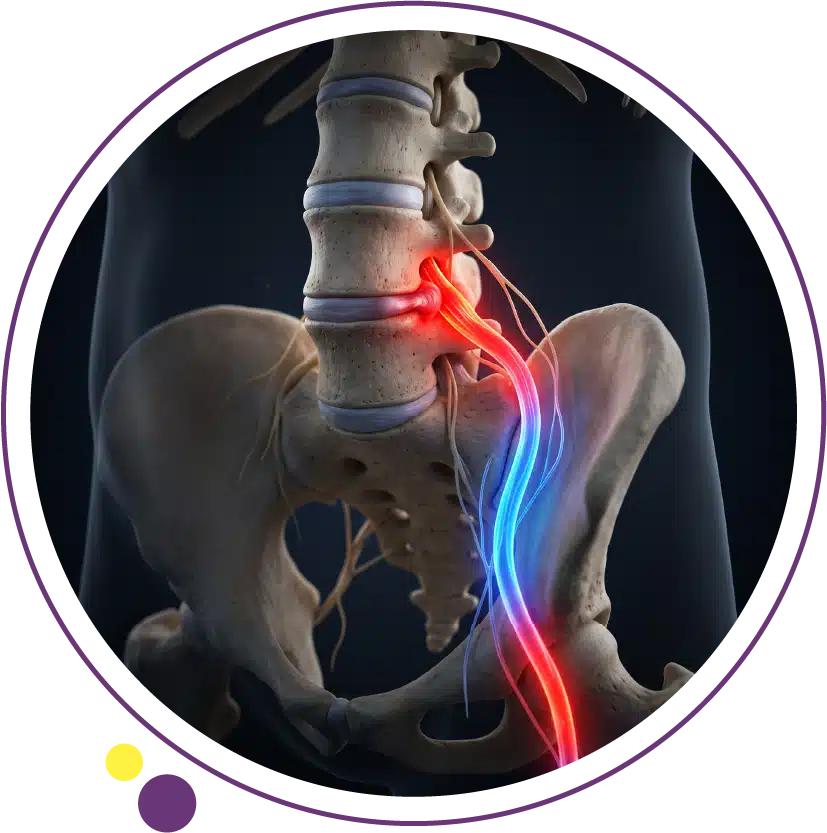
Back pain that stays in the back is one thing. Back pain that travels down one leg, accompanied by numbness or a burning sensation that follows a distinct path, is something else entirely, and it usually means a herniated disc is pressing against a nerve root rather than a muscle simply being strained. Recognising this distinct pattern of nerve involvement, and understanding exactly which numbness pattern points to which affected nerve root, helps explain why some back pain resolves in days while other cases need imaging and a clearer treatment plan.
In this article, we explain how herniated disc symptoms typically travel from the spine into a limb, describe how specific numbness patterns pinpoint the exact nerve root involved, cover the differences between lumbar and cervical disc symptoms, and clarify which warning signs demand urgent same-day evaluation rather than a routine appointment.
Why Herniated Disc Symptoms Travel Away From the Spine
Each spinal nerve root exits the spine at a specific level and travels outward to supply sensation and motor control to a defined region of the body, whether an arm or a leg. A herniated disc sits directly adjacent to these exit points, and when disc material bulges, protrudes, or extrudes toward this region, it compresses the nerve root mechanically while simultaneously triggering a local inflammatory response that amplifies the irritation.
Because each nerve root supplies a specific, mapped territory of skin and muscle, known as a dermatome and myotome respectively, the resulting symptoms are not random. They follow a predictable path that experienced clinicians can often use to identify the likely spinal level even before imaging confirms it. For the complete picture of how disc herniation develops and progresses through its stages, our comprehensive guide on herniated discs covers the full clinical background. MRI at Images Diagnostic Center in Kuwait then confirms the exact level and severity with precision that clinical examination alone cannot achieve.
Lumbar Disc Symptoms: Pain Travelling Into the Leg
Sciatica: The Hallmark Symptom
Sciatica describes pain that begins in the lower back or buttock and radiates down the leg, following the path of the sciatic nerve or one of its branches, sometimes reaching all the way to the foot in more severe cases. This pain is typically described as sharp, burning, or electric in quality, and it clearly extends beyond the back itself, which is precisely what distinguishes it from ordinary muscular back pain.
Sciatica characteristically worsens with coughing, sneezing, bending forward, or prolonged sitting, because each of these actions increases pressure within the spinal canal and against the affected disc. Clinical studies confirm that the specific pattern of leg pain distribution correlates reliably with the affected spinal level, meaning a detailed description of exactly where the pain travels gives useful diagnostic information even before imaging is performed. MRI at Images then provides the definitive confirmation of the exact level involved.
Numbness and Tingling: Reading the Dermatomal Pattern
Numbness represents a loss of normal sensation, often accompanied by a pins-and-needles tingling, appearing in a specific region of the leg or foot depending on exactly which nerve root is compressed. This is where the numbness pattern becomes genuinely useful diagnostically: numbness affecting the outer part of the lower leg and the top of the foot typically points to the L5 nerve root, while numbness affecting the sole of the foot and heel typically points to the S1 nerve root instead, and numbness on the inner shin and knee area suggests involvement further up at L4.
This precise dermatomal mapping is one of the most clinically useful tools available before imaging, since it allows a clinician to predict which spinal level is most likely responsible and focus the subsequent MRI examination accordingly. Numbness persisting for more than two weeks warrants imaging evaluation. The imaging services at Images provide this level of diagnostic precision in Kuwait.
Muscle Weakness: A More Serious Sign
Muscle weakness is a more significant finding than pain or numbness alone, since it reflects genuine impairment of the nerve’s motor function rather than only its sensory role. Patients may notice difficulty lifting the front of the foot while walking, commonly described as foot drop or catching the toes on uneven ground, weakness when trying to stand on the toes or heel, or difficulty climbing stairs due to weakness in specific muscle groups supplied by the affected nerve root.
The appearance of genuine muscle weakness, particularly if it is progressively worsening rather than stable, warrants urgent rather than routine evaluation. Progressive weakness can indicate significant nerve compression that benefits from faster intervention to avoid permanent nerve damage. Clinical research emphasises the importance of prompt evaluation when progressive motor weakness accompanies suspected disc herniation. Contact Images promptly if this symptom appears.
Cervical Disc Symptoms: Pain Travelling Into the Arm
A herniated disc in the neck produces a similar pattern but affects the upper limb rather than the leg. Pain radiates from the neck toward the shoulder and down the arm, sometimes reaching specific fingers depending on which cervical nerve root is affected. This pain frequently worsens with certain neck movements, such as bending toward the affected side or extending the neck backward to look upward for an extended period.
Numbness and weakness follow the same logic as in the lumbar spine: numbness in specific fingers or weakness gripping objects or lifting the arm points toward a particular cervical nerve root. Numbness affecting the thumb and index finger typically suggests the C6 nerve root, while numbness affecting the ring and little fingers suggests C8 involvement instead. Headaches at the base of the skull can also accompany more advanced cervical disc conditions. MRI at Images provides the precise imaging needed to confirm these cervical levels.
Warning Signs That Demand Evaluation Within Hours
Certain rare but serious symptoms require emergency evaluation without delay. Loss of bladder or bowel control, appearing as sudden urinary or faecal incontinence, is the most alarming sign and points toward possible cauda equina syndrome, a rare but genuine surgical emergency requiring intervention within hours to avoid permanent nerve damage.
Saddle anaesthesia, numbness affecting the inner thighs, buttocks, and genital region in a pattern resembling where a rider sits on a saddle, is another red flag for cauda equina syndrome requiring the same urgency. Rapidly progressive weakness in both legs, or severe weakness that prevents walking, also warrants emergency assessment. Global medical authorities classify cauda equina syndrome as a neurological emergency requiring immediate MRI and rapid surgical intervention. Images Diagnostic Center provides this urgent imaging in Kuwait.
Symptoms Warranting Evaluation Within Days
Less severe symptoms still warrant a prompt appointment within days rather than weeks: radiating pain persisting more than two weeks despite relative rest, persistent numbness in a defined area, mild but noticeable weakness such as occasionally catching the foot while walking, or pain significantly interfering with daily activity. These symptoms do not represent an emergency but do deserve MRI evaluation to identify the underlying cause and its exact severity.
Relatively early evaluation, rather than waiting weeks for symptoms to worsen further, helps guide the most appropriate treatment path from the outset. Contact Images to arrange this evaluation.
Frequently Asked Questions
How do I tell disc-related pain apart from ordinary muscle strain?
Muscle strain typically stays localised to the back itself and improves gradually within a few days. Herniated disc pain typically extends beyond the back into the leg or arm, is often accompanied by numbness or weakness, and tends to persist or worsen with specific movements like coughing or bending forward. This distinct extension beyond the back, together with any accompanying nerve symptoms, is the key distinguishing feature.
Does mild numbness always mean a herniated disc?
Not necessarily, since numbness can arise from prolonged sitting pressure or circulation issues as well. However, persistent numbness following a specific nerve distribution pattern, particularly alongside radiating back pain, raises the likelihood of a disc-related cause and warrants evaluation to confirm or rule it out.
What exactly is cauda equina syndrome?
It is a rare but genuine surgical emergency occurring when disc material severely compresses the bundle of nerves at the lower end of the spinal canal. It causes bladder or bowel incontinence and saddle-area numbness. It requires imaging and surgical intervention within hours to prevent permanent damage to bladder and bowel nerve function.
Can muscle weakness improve after a herniated disc is treated?
In many cases, yes, particularly when the underlying cause is treated before permanent nerve damage occurs. The extent and speed of recovery depend on how severe and how prolonged the compression was before treatment began, which is exactly why prompt evaluation matters when weakness appears. Contact Images to arrange early evaluation.
Nerve Symptoms Are a Signal Worth Acting On
Herniated disc symptoms that extend beyond the back into a leg or arm, accompanied by numbness or weakness, indicate genuine nerve compression that deserves proper evaluation. The vast majority of these cases respond well to treatment without surgery when diagnosed correctly and early, while the rare warning signs like bladder incontinence demand immediate action that cannot wait.
Images Diagnostic Center provides 3 Tesla MRI across two Kuwait branches:
To arrange an MRI examination, contact Images directly.