

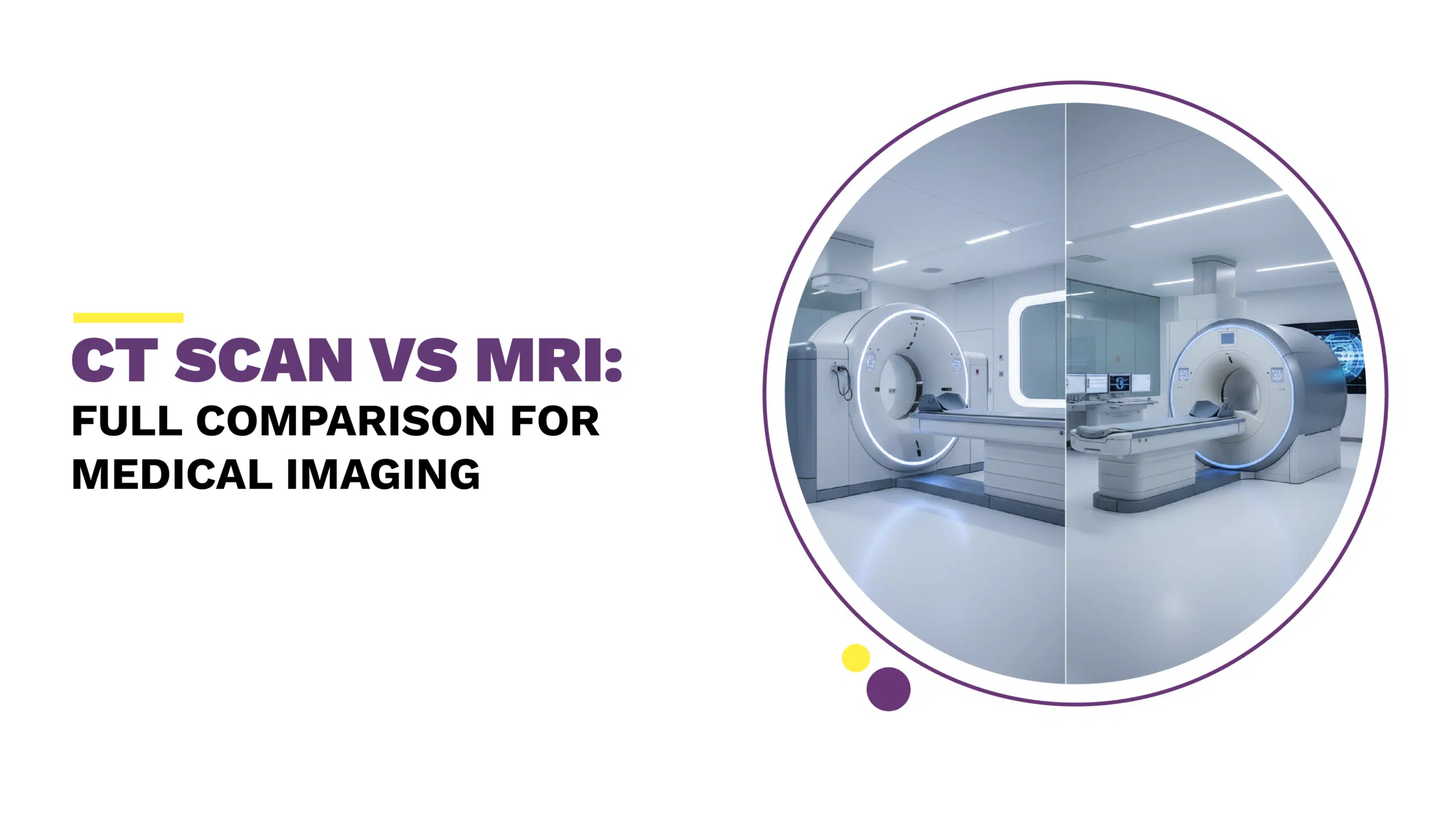
Radiology plays a central role in modern medicine, serving as the foundation for early diagnosis, treatment planning, and ongoing patient monitoring. With multiple imaging options available, patients often ask a common question when faced with deciding between a CT scan vs MRI: Should I get a CT scan or an MRI?
While both modalities offer powerful diagnostic capabilities, they rely on entirely different technologies, making each one suitable for specific medical situations.
This article provides a comprehensive breakdown, covering accuracy, safety, typical clinical indications, result speed, patient preparation, and technological differences, while highlighting how advanced systems at Images Diagnostic Center support precise, reliable diagnosis for patients and referring physicians in Kuwait.
Understanding the Core Difference Between CT and MRI
At a technical level, CT scans use X-rays, while MRI scans use magnetic fields and radiofrequency waves. This fundamental difference affects:
- The type of tissue each scan visualizes best.
- The conditions physicians aim to diagnose.
- Whether contrast is necessary.
- The level of detail (resolution) clinicians can expect.
- Safety considerations based on patient medical history.
Because the two technologies complement each other, radiologists often use them together to achieve complete diagnostic clarity.
How Does a CT Scan Work?
A CT scan (Computed Tomography) uses a rotating X-ray beam to generate cross-sectional images of the body. Modern CT scanners, such as those used at Images Diagnostic Center, produce hundreds of thin slices that can be reconstructed in multiple planes, offering rapid visualization of both bone and soft tissue.
Clinical strengths of CT scanning include:
- Superior visualization of bone structures.
- Excellent for detecting acute bleeding.
- Fast imaging for emergency and trauma cases.
- High accuracy for lung and chest evaluation.
- Clear assessment of calcifications, fractures, and vascular calcified plaques.
Because CT uses ionizing radiation, radiologists carefully adjust protocols based on the patient’s age, clinical need, and body region to ensure a safe, dose-optimized exam.
How Does MRI Work?
MRI (Magnetic Resonance Imaging) uses a powerful magnetic field and radiofrequency pulses to generate images without radiation. At Images Diagnostic Center, the use of 3 Tesla MRI provides exceptional resolution, allowing radiologists to detect even subtle abnormalities.
Clinical strengths of MRI include:
- Outstanding visualization of brain, spine, nerves, and soft tissues.
- High precision in evaluating joints, ligaments, discs, and cartilage.
- Superior assessment of tumors, inflammation, and early tissue changes.
- Safe for repeated monitoring because there is no radiation.
- Ability to produce functional, diffusion, and contrast-enhanced sequences.
For neurological, musculoskeletal, pelvic, and soft tissue imaging, MRI remains the preferred modality due to its unmatched anatomical detail.
Which Shows More Detail, MRI or CT Scan?
For soft tissues, MRI is typically more detailed. For bone and acute bleeding, CT is generally superior. At 3 Tesla MRI, the magnetic field strength significantly enhances resolution, especially for:
- Brain lesions.
- Nerve compression.
- Ligament tears.
- Disc herniation.
- Small joint injuries.
- Early inflammatory changes.
Meanwhile, advanced CT scanners excel at:
- Lung diseases.
- Bone fractures.
- Sinus and ear evaluation.
- Abdominal emergencies.
- Vascular calcium scoring.
Because Images Diagnostic Center offers both technologies at high diagnostic standards, radiologists select the modality that aligns best with each patient’s clinical requirement.
What Makes 3 Tesla MRI More Accurate?
A 3 Tesla MRI uses double the magnetic field strength of a standard 1.5T MRI. This increase results in:
- Sharper and more defined images.
- Faster scanning sequences.
- Improved detection of small or early lesions.
- Higher signal-to-noise ratio.
- Enhanced brain, spine, and joint imaging.
For example, in neurological cases such as early multiple sclerosis, micro-strokes, or subtle spinal nerve impingement, a 3 Tesla MRI scan in Kuwait provides a diagnostic advantage that directly supports accurate treatment planning.
How Fast Can CT Scan Results Be Obtained?
CT scans are typically completed within minutes, making them ideal for urgent cases. CT results at Images Diagnostic Center are interpreted rapidly by subspecialty-trained radiologists, often within hours, supporting emergency decision-making for:
- Head trauma.
- Stroke screening.
- Acute abdominal pain.
- Suspected fractures.
- Pulmonary embolism assessment.
This speed, combined with dose-optimized imaging protocols, helps physicians respond to clinical emergencies with accuracy and confidence.
Comparing CT Scan vs MRI: A Clinical Overview
Below is a simplified, patient-friendly comparison table:
| Feature | CT Scan | MRI |
| Technology | X-rays | Magnetic field + radio waves |
| Best for | Bone, lung, emergency imaging | Brain, spine, joints, soft tissue |
| Radiation | Yes | No |
| Scan speed | Very fast | Moderate |
| Detail level | Excellent for bone & bleeding | Superior for soft tissues |
| Cost | Generally lower | Higher due to technology |
| Contrast usage | Iodine-based | Gadolinium-based |
| Suitable for patients with implants | Often yes | Case-dependent (consult radiology) |
At Images Diagnostic Center, radiologists review patient history, symptoms, and referring physician notes before recommending the appropriate modality.
Clinical Scenarios: When Doctors Prefer CT or MRI
Doctors may recommend a CT scan for:
- Head injury or suspected internal bleeding.
- Lung evaluation or chronic cough.
- Kidney stones.
- Trauma injuries.
- Sinus disease.
- Cardiac calcium scoring.
- Abdominal pain (appendicitis, obstruction).
Doctors may recommend MRI for:
- Brain lesions, tumors, or neurological symptoms.
- Chronic headaches, vertigo, or unexplained dizziness.
- Disc herniation or spinal nerve compression.
- Joint injuries (shoulder, knee, hip).
- Soft tissue evaluation.
- Pelvic imaging (uterus, ovaries, prostate).
- Liver fibrosis staging with elastography.
When needed, radiologists may combine both tests, for example, CT for acute findings and MRI for soft-tissue characterization.
How Preparation Differs Between CT and MRI Scans
Preparing for a CT scan
- Fasting may be required if contrast is needed.
- Patients should inform staff of allergies or kidney disease.
- Metallic objects must be removed.
- Contrast for CT uses iodine; hydration after the exam is recommended.
Preparing for an MRI scan
- Remove all metal items (jewelry, watches, hairpins).
- Provide details of implants (pacemakers, clips, prosthetics).
- Patients with claustrophobia can request open MRI.
- Gadolinium contrast is used based on clinical need.
Images Diagnostic Center offers both standard MRI and Open MRI, improving patient comfort, especially for those with anxiety or limited mobility.
Imaging Accuracy at Images Diagnostic Center
As Kuwait’s most accredited radiology center, Images Diagnostic Center combines:
- 3 Tesla MRI,
- High-resolution CT imaging.
- Advanced ultrasound & Doppler systems.
- Digital X-ray.
- Bone density (DEXA).
- Digital mammography.
- Subspecialty radiology interpretation (neuroradiology, musculoskeletal radiology, cardiac imaging, pediatric radiology).
This ensures diagnostic accuracy across a wide range of conditions.
The Role of Ultrasound, X-ray, Bone Density, and Mammography
While CT and MRI are core modalities, other imaging tools play essential roles.
Ultrasound & Doppler
This modality excels at:
- Soft tissue and organ evaluation.
- Pregnancy imaging.
- Thyroid, abdomen, and pelvic studies.
- Vascular Doppler for blood flow assessment.
Digital X-ray
Best suited for:
- Fractures.
- Chest evaluation.
- Joint alignment.
- Infection screening.
Bone Density (DEXA Scan)
Used for:
- Osteoporosis detection.
- Fracture risk analysis.
- Monitoring response to treatment.
Mammogram
Critical for:
- Early breast cancer detection.
- Screening and diagnostic imaging.
- Monitoring high-risk patients.
Together, these services provide a full diagnostic ecosystem under the expertise of board-certified radiologists.
Home Radiology in Kuwait: When Imaging at Home Becomes Necessary
Images Diagnostic Center offers Images GO, a home radiology service in Kuwait designed for:
- Elderly patients.
- Patients with limited mobility.
- Post-operative individuals.
- Those unable to visit a clinic.
- Families requiring bedside imaging support.
Portable X-ray, ultrasound, and select diagnostic evaluations can be performed safely at home, with results interpreted by expert radiologists and shared securely with treating physicians.
Safety Considerations for CT and MRI
CT scan safety
- Uses low-dose radiation.
- Radiologists apply dose-optimization protocols.
- Not recommended for pregnant women unless clinically urgent.
- Safe for patients with implants or prosthetics.
MRI safety
- No radiation.
- Not suitable for patients with certain metal implants.
- Safe during pregnancy after the first trimester (with physician guidance).
- Patients must remain still for image clarity.
The radiology team fully reviews medical history to ensure patient-specific safety.
Which Imaging Test Should You Choose? Expert Guidance
Choosing between CT and MRI depends on:
- Clinical symptoms.
- Doctor’s objectives.
- Need for soft-tissue vs bone detail.
- Urgency of diagnosis.
- Patient safety considerations.
At Images Diagnostic Center, radiologists collaborate closely with physicians to ensure every patient receives the most appropriate imaging modality with optimal protocols.
FAQs
1. Is MRI safer than CT because it has no radiation?
Yes, MRI does not use radiation, making it appropriate for repeated follow-ups. However, both tests are safe when medically justified.
2. Can CT or MRI detect early tumors?
MRI is excellent for soft-tissue tumors, while CT is helpful for lung and abdominal masses. Radiologists select the test based on the suspected location.
3. Do CT scans require contrast?
Not always. Contrast is used only when needed to enhance blood vessels or organs.
4. How long does a full MRI take?
Most MRI scans take 20–45 minutes depending on the body part and sequences.
5. Can children undergo CT or MRI safely?
Yes, pediatric-specific protocols ensure radiation reduction for CT, and MRI is radiation-free.
6. Is fasting required before CT or MRI?
Fasting is required only for specific contrast-enhanced scans. Patients are informed in advance.
Book Your Imaging Test Today
Advanced Radiology Services in Kuwait
If you need MRI, CT scan, Ultrasound, Mammogram, Bone Density, or Home Radiology, Images Diagnostic Center provides accurate, safe, and patient-centered imaging across Kuwait.
Locations:
- Phone: (+965) 1899 888
- Email: info@imagesforhealth.com
For precise answers and expert radiology interpretation, schedule your scan with Kuwait’s most accredited imaging center.