

A look inside three years of breast imaging at Images, and what it means for you
Images Radiology · Breast Cancer Awareness Month 2026 · Medical review: Dr. Nesma Wageih, Radiologist.
Every October, Breast Cancer Awareness Month reminds us how much early detection matters. This year we looked back at three years of breast imaging at Images: 5,321 mammogram, breast ultrasound and breast MRI reports for 4,170 women, from October 2023 to September 2026.
We did not look at names or files. We combined the results into anonymous totals, to understand what women in our community really see in their reports, and to answer the questions we hear every day.
The big picture: 9 in 10 results were reassuring
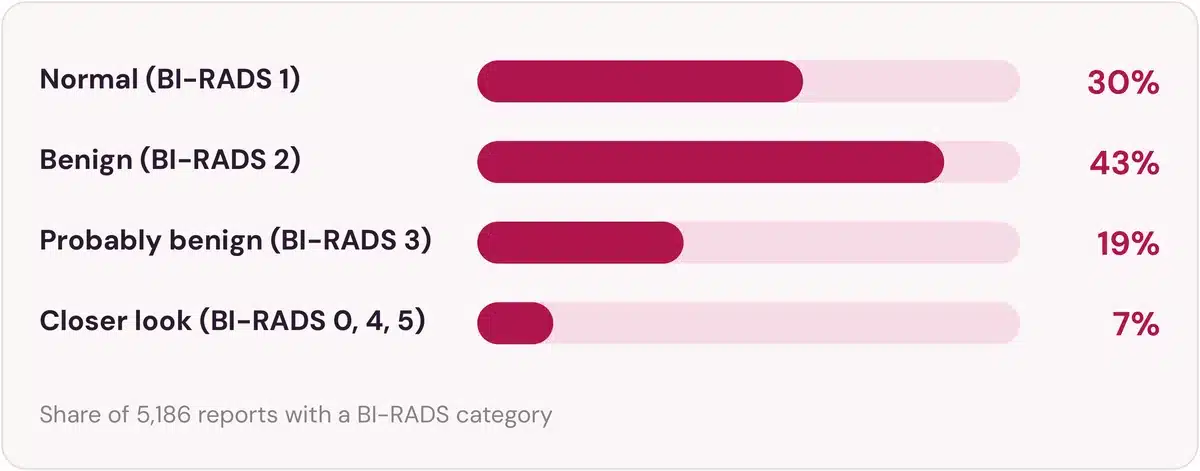
30% of reports were normal, 43% showed only benign (non-cancerous) findings, and 19% were probably benign. About 7 in 100 asked for a closer look: more images, or a biopsy.
A breast check is far more likely to bring peace of mind than bad news. And when something does need a closer look, finding it early is exactly the point of checking.
Understanding BI-RADS
Your breast imaging report ends with a BI-RADS category, the international 0 to 6 scale radiologists use to describe results:
- 0Incomplete: more images are needed before a final answer.
- 1Normal: nothing to report.
- 2Benign: a finding that is not cancer, such as a simple cyst.
- 3Probably benign: a very low chance of cancer; a short-interval follow-up is advised.
- 4Suspicious: a biopsy is advised to find out what it is.
- 5Highly suspicious: a biopsy is needed.
- 6Known cancer: used during treatment.
“Probably benign” means follow up, not worry
About 1 in 5 reports (19%) were BI-RADS 3. This category carries a very low chance of cancer, under 2%, but your radiologist asks for a follow-up scan, usually in 6 months, to make sure the finding stays stable.
Please keep that appointment, even if you feel completely well. It is the step that turns “probably” into “certainly”.
Dense breasts are common, and they matter
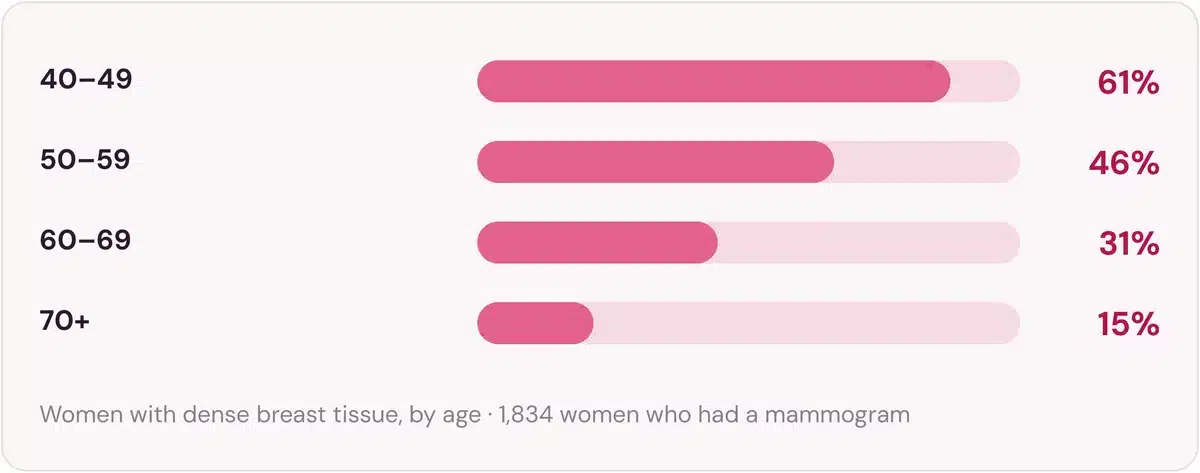
About half (51%) of the women who had a mammogram with us had dense breast tissue (categories C or D). It is most common in the 40s and becomes less common with age.
Dense tissue is completely normal. But on a mammogram it looks white, just like some small changes can, so it can hide them. That is why we often add a breast ultrasound for women with dense breasts.
What we see most often
Among the 3,897 reports that described any finding, the most common were cysts (33%), calcifications (32%), normal lymph nodes (29%) and fibroadenomas (22%).
Most of these are common and harmless: simple cysts are fluid sacs, most calcifications are benign, and fibroadenomas are benign lumps often seen in younger women. Only your radiologist can tell what a finding means for you, so always go through your report with your doctor.
Screening works best when it is regular
87% of women came to us only once in three years. Breast screening is most useful as a habit: a yearly mammogram from 40, or as your doctor advises. Women with a strong family history may need to start earlier or add MRI.
Breast health is not only a concern for later in life: 1 in 3 women we scanned were under 40, usually with an ultrasound.
See your doctor promptly if you notice
- A new lump or thickening in the breast or armpit
- A change in the size or shape of a breast
- Skin dimpling, puckering or redness
- Nipple changes or discharge, especially if bloody
- Pain in one spot that does not go away
How we looked at the data
All figures are anonymous totals: no names, files or individual results were published. BI-RADS categories were read from the written reports with an AI-assisted tool, checked against the report text, and flagged cases were reviewed by our team.
These numbers describe women who came to Images, many of them because of symptoms or for follow-up. They are not the rate of breast conditions in the general population.
Your yearly check matters
This October, book your breast check at Images Jabriya: WhatsApp or call 1899888, or visit book.imagesforhealth.com.
This article is for general information and awareness. It is not medical advice. Please talk to your doctor about your own health, symptoms and screening plan.