
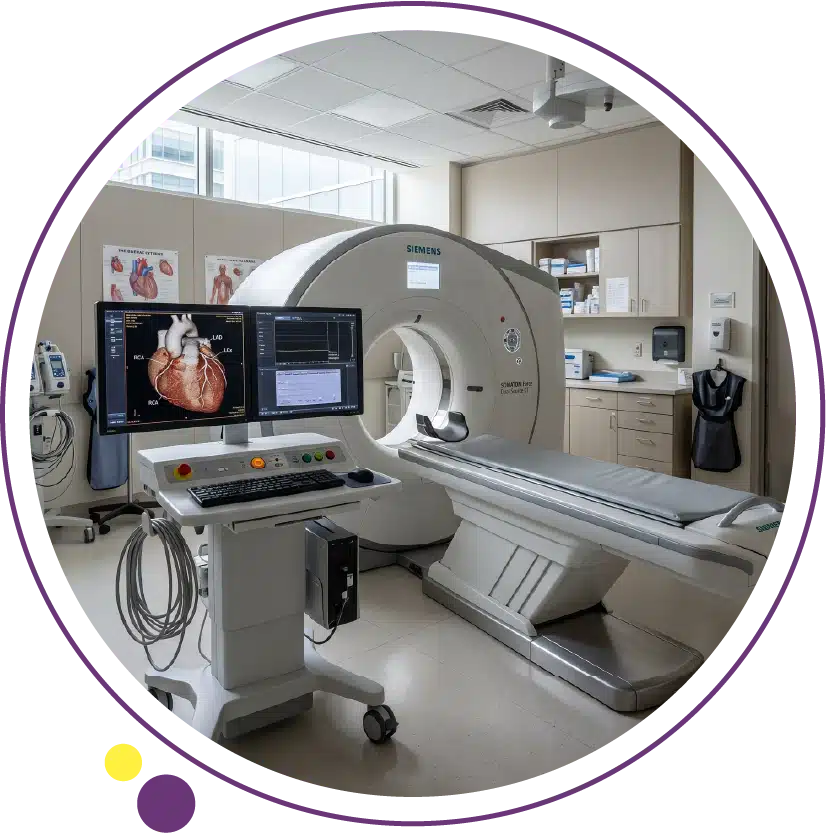
A coronary CT is a heart imaging test used to look at the arteries that supply blood to the heart. In practice, many patients mean coronary CT angiography, also called coronary CTA, while others are asking about a coronary calcium scan, which measures calcium buildup in the coronary arteries. At Images Diagnostic Center, understanding that difference matters because these scans answer different questions and are not ordered for the same reason.
A coronary CT can help show plaque, narrowing, and calcium-related heart risk, but it is not the right test for every patient with chest symptoms. In this article, we will discuss what coronary CT shows, how it differs from calcium scoring, who it may help, how to prepare, what the risks and benefits are, and what the next step usually looks like after the scan.
What is a coronary CT?
The term coronary CT usually refers to one of two related heart CT exams. A coronary CT angiography exam uses IV contrast to look directly at the coronary arteries and assess plaque or narrowing, while a calcium scan is a non-contrast heart CT that measures calcified plaque and estimates future risk rather than showing blood flow in detail. That is why patients reviewing our Cardiac CT and general CT Scan pages should not assume every cardiac CT is the same test.
Coronary CTA is designed to evaluate the heart’s arteries using CT images and iodine-based contrast. A calcium scan, by contrast, focuses on calcium deposits and risk assessment. In everyday patient language, one test is more about looking at the artery anatomy now, while the other is more about estimating plaque burden and future cardiovascular risk. At Images Diagnostic Center, that distinction helps decide whether the more relevant route is Cardiac CT, Cardiac MRI, or another exam from our wider Services pathway.
What does a coronary CT show?
A coronary CTA can show plaque buildup, coronary artery narrowing, and in many cases the extent of disease within the arteries that feed the heart. It may also help identify other causes of symptoms in selected situations, which is one reason it is used carefully in symptom-based workups rather than as a generic scan for everyone. If your doctor is deciding between heart-focused imaging options, our Cardiac CT and Services pages are the most relevant starting points.
A coronary calcium scan shows calcium deposits in the coronary arteries. Calcium in these arteries suggests atherosclerotic plaque, and higher calcium levels are associated with higher future cardiovascular risk. That is why a calcium score can matter even in people who do not yet have clear symptoms, especially when the question is how aggressively to manage prevention. At Images Diagnostic Center, this is where Cardiac CT becomes relevant as a decision-supporting test rather than just another scan.
It is also important to know what coronary CT does not do. A calcium scan does not replace a full coronary CTA, and neither one replaces a cardiologist’s judgment, ECG findings, lab work, or emergency evaluation when symptoms are severe. That is why our Contact page is most useful after a doctor has defined the question clearly, especially if the issue is active chest pain or uncertainty about the right test.
Who may benefit from a coronary CT?
Coronary CTA is often considered for people with low to intermediate risk of coronary artery disease who have chest pain, unclear ECG or lab results, non-acute chest pain, an inconclusive stress test, or new symptoms despite a previously normal stress test. It may also be used in selected patients before certain cardiac procedures or surgeries. For patients in that situation, our Cardiac CT page and broader Services overview help frame where the scan fits in the workup.
A coronary calcium scan is often more useful when risk is uncertain rather than clearly low or clearly high. Official patient guidance notes that it may be considered when someone has an intermediate or unclear heart attack risk or a strong family history of early coronary disease. In other words, this is often a risk-clarifying exam, not a one-size-fits-all screening test. That distinction matters when comparing Cardiac CT with other options such as Cardiac MRI or general CT Scan.
Who may not be the right candidate?
Not everyone with chest discomfort should go straight to outpatient coronary CT. If someone has severe or ongoing chest pain, fainting, marked shortness of breath, or emergency symptoms, urgent medical care comes first. A planned Cardiac CT is most useful when the question is stable enough for imaging-based evaluation rather than immediate emergency treatment.
There are also technical and medical limitations. Radiology guidance notes that image quality may be compromised in some patients with very fast or irregular heart rhythms, and contrast-based CTA requires attention to kidney function, allergies, and certain medications. That is why our Contact team may ask about your referral details before confirming the most appropriate exam from our Services range.
For calcium scoring specifically, Mayo Clinic notes that it is not generally recommended as a routine screening test for people already known to be at high risk, or for those who have already had a heart attack, stent, or bypass surgery. In those situations, the clinical question is usually more advanced than a calcium score alone can answer, and another pathway through Cardiac CT, Cardiac MRI, or direct cardiology care may make more sense.
Coronary CTA vs calcium score
Patients often use these terms interchangeably, but they are not interchangeable exams. A coronary CTA uses contrast material, aims to visualize the coronary arteries more directly, and is usually ordered when the doctor wants to look for plaque and narrowing. A calcium scan does not use contrast and is mainly about measuring calcified plaque burden and future risk. That is why our Cardiac CT service should always be matched to the exact referral question.
A calcium scan result is usually reported as an Agatston score. Mayo Clinic’s patient guidance explains that a score of 0 means no visible calcium, higher scores mean more calcium burden, scores from 100 to 300 suggest moderate plaque deposits, and scores above 300 suggest more extensive disease and higher heart attack risk. That score does not stand alone, though, and should be interpreted together with age, symptoms, cholesterol profile, blood pressure, diabetes status, and family history. Our Cardiac CT page is most useful when the scan result is being linked back to a real clinical plan.
This is also where many patients benefit from understanding that not all CT exams answer the same question. If you want a broader comparison of how CT is used across different medical situations, our previously published guide to types of CT scan can help place coronary CT in the right context.
How should you prepare?
Preparation depends on the exact test. For coronary CTA, RadiologyInfo notes that patients are commonly asked to avoid caffeine, avoid medications such as Viagra or similar drugs, and not eat or drink for several hours before the exam if contrast will be used. Some patients are also given a beta blocker to lower the heart rate so the coronary images are clearer. If your referral is for Cardiac CT, our Contact page is the right place to confirm the specific instructions for your appointment.
For a calcium scan, preparation is usually simpler. RadiologyInfo states that no special preparation is generally needed, but patients are usually told to continue usual medications and avoid caffeine and smoking for four hours beforehand. That makes calcium scoring easier for many outpatients, but it still should be ordered for the right reason rather than as a casual add-on test. At Images Diagnostic Center, the referral reason remains the most important factor in choosing between Cardiac CT and other imaging options.
What happens during the scan?
During coronary CTA, you usually lie on the CT table with ECG leads attached so the scanner can time the images to your heartbeat. An IV line is placed for contrast, and some patients receive heart-rate-lowering medication or nitroglycerin to improve visualization of the coronary arteries. The scan itself is usually quick, but the preparation may take longer than the actual image acquisition. Patients arranging this through Cardiac CT often find it helpful to review our general CT Scan page too.
During a calcium scan, the process is usually shorter and simpler because no contrast is typically required. Mayo Clinic notes that the test often takes about 10 to 15 minutes, though prep time and heart-rate control can vary depending on the setting. Patients can usually return to normal activity afterward unless their clinician says otherwise. That practical simplicity is one reason Cardiac CT is sometimes used to clarify risk before more invasive decisions are made.
Benefits, risks, and limitations
One major benefit of coronary CTA is that it is non-invasive compared with catheter angiography, which uses a catheter inserted through an artery. RadiologyInfo notes that catheter angiography is more invasive and has more procedure-related recovery and access-site issues, while CTA is generally faster and simpler as an imaging test. That makes Cardiac CT especially helpful when the goal is evaluation rather than immediate intervention.
The main risks are tied to radiation and, for CTA, iodinated contrast. Official guidance notes that clinicians screen for kidney disease and contrast-related concerns, and some patients may feel warmth, flushing, or a metallic taste during the injection. There can also be temporary side effects from beta blockers or nitroglycerin, such as dizziness or headache. These are some of the reasons our Services and Contact pages are important before the exam, especially when the referral involves heart disease, diabetes, kidney issues, or medication interactions.
Coronary CT also has limitations. Poor heart-rate control, marked obesity, and certain rhythm problems can reduce image quality, and a calcium scan is a risk tool rather than a complete explanation of every chest symptom. In some patients, the next step after Cardiac CT may still be additional testing, medical treatment, or cardiology review rather than an immediate final answer.
Planning the right next step in Kuwait
The value of a coronary CT depends on asking the right question first. Some patients need coronary CTA because the doctor wants a non-invasive look at plaque and narrowing, while others need a calcium score because the issue is long-term risk assessment rather than immediate anatomy. If your symptoms, referral, or previous heart tests are already available, reviewing the right Cardiac CT or Services page before booking can make the next step much clearer.
If your doctor has already recommended heart imaging, the most practical next step is to review our Cardiac CT page or reach out through Contact to confirm the right exam and preparation instructions.
FAQ
- Is coronary CT the same as a calcium scan?
No. A coronary CTA uses contrast to look more directly at the coronary arteries, while a calcium scan measures calcified plaque burden and future risk. If your doctor is deciding between the two, our Cardiac CT and Contact pages can help you match the test to the actual referral reason.
- What does a calcium score actually mean?
A calcium score estimates how much calcified plaque is present in the coronary arteries. A score of 0 suggests no visible calcium, while higher scores suggest greater plaque burden and higher cardiovascular risk, especially when the score rises above 100 or 300. The result is most useful when interpreted with the rest of the heart-risk picture, not on its own, which is why our Cardiac CT page should be viewed as part of a wider Services plan.
- Is coronary CT right for chest pain?
Sometimes, but not always. Radiology guidance supports careful use of coronary CTA in selected patients with low to intermediate risk chest pain, non-acute symptoms, or inconclusive earlier testing, but emergency symptoms need urgent medical care first. If the referral is stable and outpatient, Cardiac CT may be part of the pathway.
- Do I need contrast for coronary CT?
For coronary CTA, yes, contrast is usually part of the exam because it helps show the coronary arteries clearly. A calcium scan is different and usually does not require contrast, which is one reason the preparation and clinical use are not the same. Our Contact page can help confirm which kind of Cardiac CT has been requested for you.
- Can coronary CT replace catheter angiography?
Not completely. Coronary CTA is non-invasive and can provide valuable diagnostic information, but catheter angiography is still used when direct invasive evaluation or treatment is needed. At Images Diagnostic Center, Cardiac CT is best understood as part of the decision pathway, not as a replacement for every cardiology procedure.