
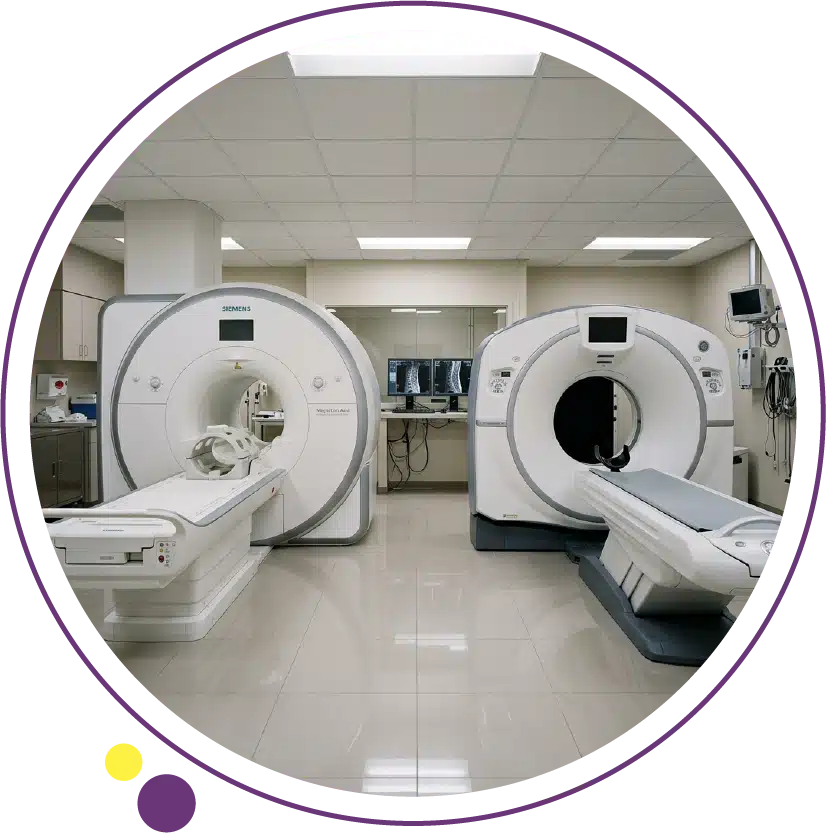
Sciatica diagnosis usually starts with a simple idea: does the patient’s pain follow the pattern of irritated nerve roots in the lower back, or is something else causing the symptoms? Sciatica is not a separate disease. It is a symptom pattern, most often caused by compression or irritation of a lumbar or sacral nerve root, usually from a herniated disc or bony narrowing in the lower spine.
For many patients, the symptoms feel very specific. Pain may begin in the lower back or buttock and travel down one leg, often with numbness, tingling, or weakness. Even so, doctors do not diagnose sciatica from pain alone. They combine the symptom pattern with a physical examination, and only use imaging when it is likely to change management or when red flags suggest a more serious cause.
For Images Diagnostic Center in Kuwait, this is an important distinction. Not every patient with leg pain needs a scan. But when symptoms are severe, progressive, or linked to warning signs such as bladder changes, saddle numbness, bilateral symptoms, infection, cancer, or major weakness, imaging such as MRI or, in selected cases, CT scan may be recommended urgently.
What is sciatica diagnosis based on?
The first step in sciatica diagnosis is clinical assessment. Doctors usually begin by asking where the pain starts, where it travels, whether it extends below the knee, and whether there is numbness, tingling, or weakness. They also ask what makes the symptoms worse, such as sitting, coughing, sneezing, or straining. A typical lumbar radiculopathy pattern often points toward the diagnosis.
Sciatica usually affects one leg and often feels more prominent in the leg than in the lower back. That detail matters because not all back pain with leg discomfort is true nerve-root pain. Doctors also consider whether the symptoms fit other conditions such as hip disease, peripheral nerve disorders, vascular problems, infection, fracture, or spinal tumor.
In uncomplicated cases, this clinical assessment is often enough to guide early care. The goal is not to rush every patient toward imaging, but to identify who needs routine conservative care and who needs urgent investigation.
What tests do doctors perform during sciatica diagnosis?
Doctors usually perform a focused neurologic and musculoskeletal examination. During the physical exam, a healthcare professional may check muscle strength and reflexes. Patients may be asked to walk on their toes or heels, rise from a squat, or lift the legs one at a time while lying on their back.
These bedside tests help answer practical questions:
- Is there a true weakness?
- Are reflexes reduced?
- Does the symptom pattern fit a specific nerve root?
- Is the problem staying stable or getting worse?
When nerve conduction is affected, weakness may follow a myotomal pattern and numbness may follow a dermatomal pattern. Diminished reflexes can also support the diagnosis of radiculopathy.
Doctors may also arrange additional tests in selected cases. People with severe pain or pain that does not improve within a few weeks may need imaging or electromyography. EMG can help confirm how severe a nerve-root injury is, especially when the diagnosis is uncertain or when symptoms and imaging do not fully match.
When is MRI recommended urgently for sciatica?
MRI is not usually the first step in every case of sciatica. Routine imaging is not generally recommended in non-specialist care for uncomplicated low back pain with or without sciatica, because scans often do not change early management and may show age-related changes that are not actually causing symptoms.
Urgent MRI becomes much more important when red flags raise concern about serious pathology. Urgent referral to a spinal surgery service or urgent MRI, within 2 weeks, may be needed if there is suspicion of tumor or infection, or if red flags are present in the context of severe or progressive neurologic symptoms.
In real clinical practice, MRI is often urgently considered when:
- severe or progressive leg weakness is developing
- pain and neurologic findings suggest major nerve compression
- symptoms are not following the expected recovery pattern
- infection or tumor is suspected
- the patient may need specialist spinal assessment or intervention
MRI is usually preferred because it shows discs, nerve roots, spinal canal narrowing, inflammation, and soft tissues clearly. That makes it the most informative test when the concern is nerve compression rather than bone injury alone. This is why MRI in Kuwait is often the key imaging study in complicated or persistent sciatica.
When is CT used in sciatica diagnosis?
CT is not the first choice for most routine sciatica questions when MRI is available and appropriate. However, CT still has an important role. CT can be used in sciatica evaluation, and a CT myelogram may be performed in some cases by injecting dye into the spinal canal to make the spinal nerves easier to see.
Doctors may choose CT scan in Kuwait instead of MRI when:
- MRI is contraindicated or not suitable
- rapid imaging is needed and CT is more accessible
- bony detail is especially important
- trauma is part of the presentation
- a special study such as CT myelography is needed
This means CT is not “better” than MRI in a general sense. It is simply more useful in certain clinical situations. The right imaging test depends on the patient’s symptoms, safety factors, and the exact question the doctor is trying to answer.
Which red flags require immediate referral and imaging?
This is the most important part of sciatica diagnosis. Most sciatica is painful but not dangerous. But some red flags can point to severe nerve compression or other serious spinal disease that should not wait.
The most urgent concern is cauda equina syndrome. Symptoms such as bladder or bowel dysfunction, saddle or genital numbness, bilateral leg symptoms, and rapidly worsening weakness are major warning signs.
Red flags that should trigger immediate emergency assessment include:
- new difficulty starting urination
- loss of bladder control
- loss of bowel control
- reduced sensation when passing urine or stool
- numbness around the genitals, anus, or buttocks
- bilateral leg pain
- severe or progressive weakness in one or both legs
- rapidly worsening neurologic symptoms
These symptoms are time-sensitive because delayed recognition can lead to permanent bladder, bowel, sexual, and lower-limb dysfunction. That is why suspected cauda equina syndrome is treated as a medical emergency, not a routine outpatient problem.
Which other red flags can make sciatica more concerning?
Not every urgent case is cauda equina syndrome. Doctors also watch for red flags suggesting serious underlying conditions such as spinal fracture, cancer, and infection. Suspicion is higher when pain is unexplained, unusually severe, associated with systemic illness, or linked to a cancer history or infection risk.
Doctors may become more concerned when sciatica-like pain is accompanied by:
- fever or signs of infection
- unexplained weight loss
- known cancer history
- major trauma
- constant pain not fitting a mechanical pattern
- symptoms that are worsening instead of stabilizing
In those cases, specialist referral and imaging are often appropriate because the goal is no longer just to confirm radiculopathy. It is to rule out serious disease that could mimic or complicate sciatica.
Does everyone with sciatica need imaging?
No. This is one of the most important points for patients. Many people with sciatica improve naturally, often within 6 to 12 weeks.
That is why imaging is not always helpful early on. A scan may show common age-related changes, disc bulges, or degeneration that are not actually the cause of the pain. If the patient has no red flags and symptoms are improving, conservative management is usually more appropriate than immediate imaging.
Imaging becomes more useful when symptoms persist beyond the expected recovery period, do not respond to treatment, are worsening, or are serious enough that surgery, injection, or specialist referral is being considered.
What should patients expect if imaging is ordered?
If your doctor orders MRI, the scan is usually painless and does not use ionizing radiation. You lie still while the machine takes detailed images of the lumbar spine. MRI is often preferred for sciatica because it shows discs, nerve roots, and spinal soft tissues clearly.
If CT scan in Kuwait is ordered instead, the scan is usually quicker and may be chosen because MRI is unsuitable or because CT can answer the question more effectively in that case. Some patients may need CT myelography, which is a more specialized test.
In both cases, the scan result must still be interpreted in context. Imaging supports the diagnosis, but it does not replace the doctor’s judgment about symptoms, neurologic findings, and the overall pattern of illness.
Can a doctor diagnose sciatica without an MRI?
Yes, often they can. Many cases of sciatica can be diagnosed clinically through the history and physical exam. Examination findings such as strength, reflexes, heel walking, toe walking, and pain provocation are central to early evaluation.
MRI becomes more important when the clinical picture is severe, unclear, prolonged, or urgent. So the question is not “Can sciatica be diagnosed without MRI?” but rather “Will MRI change management in this case?” In uncomplicated cases, the answer is often no. In red-flag cases, the answer may be yes and urgently so.
Frequently asked questions
- Is MRI always better than CT for sciatica?
Not always. MRI is usually preferred for nerve-root compression because it shows discs and nerves more clearly, but CT may be used when MRI is not suitable or when CT answers the clinical question better.
- What symptoms make sciatica an emergency?
The biggest emergency red flags are bladder or bowel dysfunction, saddle numbness, bilateral leg symptoms, and severe or progressive weakness. These can suggest cauda equina syndrome and need immediate assessment.
- How long should sciatica last before imaging is considered?
There is no single rule for everyone, but imaging is more often considered when pain is severe, not improving after several weeks, worsening, or associated with neurologic deficits or red flags.
- Can EMG help in sciatica diagnosis?
Yes, in selected cases. EMG can confirm how severe a nerve-root injury is, especially when symptoms are persistent or the diagnosis is less clear.
- Can both legs be affected in sciatica?
Typical sciatica is often one-sided. Bilateral symptoms are less typical and are more concerning, especially if they occur with bladder, bowel, or saddle sensory changes.
- Does everyone with sciatica need a specialist referral?
No. Many people improve with conservative care. Referral becomes more important when red flags are present, neurologic deficits are progressing, symptoms persist, or imaging or intervention is being considered.
Your diagnostic journey at Images for Health
Understanding sciatica diagnosis helps patients know when symptoms can be monitored conservatively and when they need urgent imaging and specialist input. Early diagnosis matters most when red flags are present, because timely MRI or CT can help identify severe nerve compression, spinal infection, tumor, or another serious cause behind nerve pain. Accurate radiology supports better medical decision-making by clarifying the cause of symptoms and helping doctors plan referral, follow-up, and treatment safely. In a specialized medical Images Diagnostic Center in Kuwait, patient comfort, safety screening, and clear image interpretation all contribute to better diagnostic confidence.
Core services available at Images for Health in Kuwait include:
Patients may contact us for more information or to arrange an appointment when imaging has been recommended. Images for Health supports trusted radiology services and advanced diagnostic imaging in Kuwait, with a focus on diagnostic quality, patient-centered care, and reliable imaging support for spine, nerve, and musculoskeletal evaluation.